China Top 10 Air Hose Reel Manufacturers for Global Buyers
Choosing an air hose reel from China requires more than comparing prices or browsing attractive product photographs. Global buyers must examine materials, pressure ratings, hose compatibility, retraction control, mounting options, and after-sales support. A reliable reel should work smoothly in workshops, factories, garages, and outdoor service areas. It should also protect the hose from sharp bends, contamination, and unnecessary wear.
Industrial hose specialist Michael R. Hayes offers a practical reminder: “A reel is only as dependable as its installation, inspection, and daily handling.” This principle guides our review of China’s leading air hose reel manufacturers. We consider production experience, export capability, quality management, customization services, and evidence of consistent performance. Factory audits, product documentation, and customer feedback matter more than polished marketing language.
The companies in this guide serve different needs. Some focus on compact manual reels for light-duty workshops. Others produce heavy-duty automatic systems for manufacturing lines, vehicle maintenance, and construction environments. Their designs may include steel frames, impact-resistant polymer housings, swivel joints, locking mechanisms, and replaceable hoses.
No ranking is permanent. Supplier capabilities change, and published specifications are not always easy to compare. That is why buyers should request current test reports, installation instructions, sample units, and warranty terms before making a decision. Small details matter. A poorly positioned outlet can shorten hose life, while weak retraction control can create avoidable safety concerns. This introduction presents a practical starting point for evaluating the top 10 air hose reel manufacturers in China.
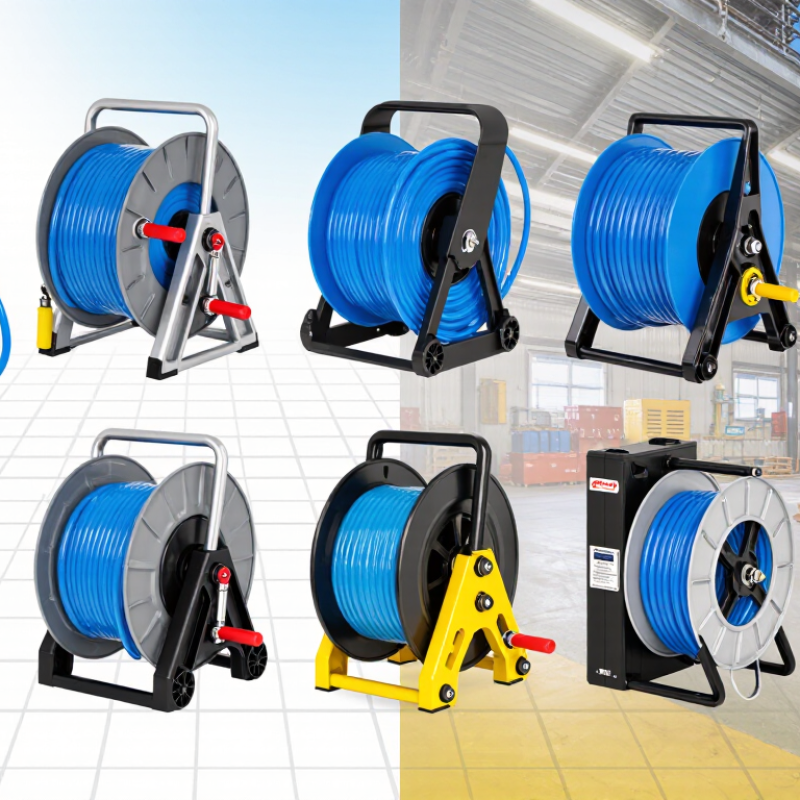
What Air Hose Reels Are and How They Work
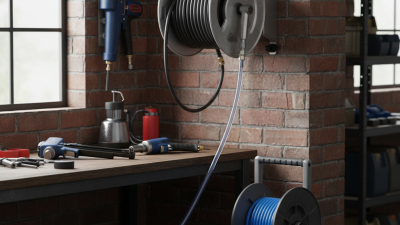
An air hose reel stores a flexible hose on a rotating drum, helping keep workshop floors clear and reducing kinks. It is commonly mounted on a wall, ceiling, workbench, or service vehicle. The reel’s frame supports the drum, while a guide helps the hose wind evenly. It feels simple. Yet a poorly placed reel can make routine work awkward.
Many models use a spring to retract the hose after use. Pulling the hose turns the drum and loads the spring; a latch may hold it at the chosen length. A gentle tug often releases the latch, allowing controlled rewind. Manual versions use a hand crank, while powered designs use a motor. Inside the assembly, a swivel connection carries compressed air from the fixed inlet into the rotating drum and hose. That joint lets the drum turn without twisting the supply line.
Before selecting or installing a reel, check the hose length, inner diameter, pressure rating, and air-tool demand. A narrow hose may restrict airflow, even when the compressor can supply enough air. Mount the reel so the hose can extend without rubbing sharp edges. Leave room for its swing and service access. In practice, layouts are not always neat; a reel mounted slightly off-angle may wind unevenly and snag. Inspect the hose, fittings, and rewind action regularly, and stop using the reel if you notice leaks, cracks, or damaged components.
How to Evaluate Chinese Air Hose Reel Manufacturers
How to Evaluate Chinese Air Hose Reel Manufacturers
Evaluate a manufacturer by evidence, not a polished catalogue. Ask for rated working pressure, hose diameter, temperature range, rewind-cycle results, and leak-test records. Check that test conditions match your intended compressor and workshop environment. A sample reel should rewind smoothly, lock at several points, and remain stable when the hose is pulled sideways. Small details matter.
The U.S. Department of Energy’s Improving Compressed Air System Performance guide reports that leaks can waste 20–30% of compressor output in poorly maintained systems. That makes reliable hose connections and documented leak checks practical buying criteria, not minor extras. Request batch traceability and a written inspection plan, then compare the paperwork with a physical sample. ISO 4414 provides safety principles for pneumatic systems, but it does not certify every reel or replace product-specific testing. Ask who conducted each test and when. A missing record is worth discussing. I would also check spare-part availability and confirm whether replacement springs and seals can be sourced consistently. A low quotation may still fit your needs, but only if the reel performs predictably after repeated use.
How to Evaluate Chinese Air Hose Reel Manufacturers
Suggested evaluation weighting for global buyers selecting air hose reel suppliers.
Use these weights as a practical starting point and adjust them to match your application, market requirements, and purchasing priorities. They are suggested evaluation weights, not measured market statistics or supplier ratings.
Profiles of China’s Top 10 Air Hose Reel Manufacturers
China’s ten manufacturer profiles reveal different strengths in air hose reel production. Some focus on compact wall-mounted units for repair bays. Others build enclosed reels for dusty workshops or mobile service vehicles. The practical details matter: steel thickness, spring return consistency, swivel-joint sealing, and hose replacement access. A smooth pull is useful. A jammed rewind is not.
Grand View Research’s Industrial Hose Market Size, Share & Trends Analysis Report estimated the global industrial hose market at USD 13.0 billion in 2023. That figure covers industrial hoses broadly, not air hose reels alone. It signals a substantial market, but does not prove any supplier’s product quality. Buyers should check test records, material specifications, and production traceability directly.
The profiles compare manufacturers by product range, customization capacity, quality controls, and export experience. One may suit high-volume standard orders; another may offer more flexible fittings or reel dimensions. Ask for a sample unit and inspect its mounting plate, hose guide, and connection points. Catalog photos can hide weak details. A small limitation remains: public factory information is uneven, so profile comparisons are only as reliable as the evidence each manufacturer provides.
China Top 10 Air Hose Reel Manufacturers for Global Buyers – Profiles of China’s Top 10 Air Hose Reel Manufacturers
This non-ranked comparison summarizes product and supplier details buyers commonly evaluate. It does not assign specifications to unnamed manufacturers; exact features, ratings, and certifications vary by model and should be confirmed with each supplier.
| Profile Dimension |
Common Product Options |
What Global Buyers Should Verify |
| 1. Rewind mechanism |
Spring-rewind, hand-crank, and powered reel designs are available in the broader air-hose-reel market. |
Ask how retraction is controlled, whether the hose can be stopped at multiple lengths, and what maintenance the mechanism requires. |
| 2. Reel enclosure |
Products may use an open-frame design or a covered enclosure. Enclosures can help shield the hose and reel components from contact and debris. |
Check access for inspection, drainage and cleaning needs, and suitability for the intended indoor or outdoor location. |
| 3. Hose material |
Air hoses may be made from materials such as rubber, PVC, or polyurethane; flexibility and environmental suitability depend on the specific formulation and construction. |
Confirm the material, hose construction, temperature limits, and compatibility with the work environment. |
| 4. Hose length |
Available hose lengths vary by reel model and hose size. Longer hose capacity generally requires a reel designed for that capacity. |
Request the usable hose length for the exact hose diameter and confirm that the reel is rated to store it safely. |
| 5. Hose inside diameter |
Reels are configured for different hose inside diameters, which affect airflow capacity and compatibility with the connected tools. |
Match the hose diameter to the tool’s air-consumption requirements and verify the reel’s inlet and outlet sizes. |
| 6. Working pressure |
Pressure ratings are model-specific and depend on the hose, fittings, swivel, and reel assembly. |
Check the rated working pressure of the complete assembly—not just the hose—and ensure it meets the system’s requirements. |
| 7. Mounting arrangement |
Depending on the design, reels may support wall, ceiling, floor, bench, or vehicle mounting. |
Confirm the approved mounting positions, mounting hardware, installation clearances, and load requirements. |
| 8. Air connections |
Connection types and thread standards vary by product and target market; adapters may be needed when standards differ. |
Specify the required thread standard, size, and connection type for both the air supply and tool end. |
| 9. Retraction and hose control |
Many retractable designs use a locking or stopping mechanism to hold the hose at a selected extension; operation differs by model. |
Request operating instructions and test the lock, retraction speed, and hose guide during sample evaluation. |
| 10. Supplier documentation and quality checks |
Documentation and inspection practices are supplier- and order-specific; they should not be assumed from a product listing alone. |
Request product drawings, test records, inspection criteria, packaging details, and any applicable certificates for the exact model and destination market. |
How Global Buyers Can Compare Suppliers and Choose a Manufacturer
When comparing suppliers from a China-based top-ten shortlist, look beyond product photos and headline prices. Match each reel to its working pressure, hose diameter, length, and mounting position. Ask for a test report that states the pressure and inspection method. Ask how the spring retracts after repeated use. Small details matter: a sharp edge near the hose guide can cause wear over time. Ask for a sample if your application is demanding.
Check materials and build consistency. Request details on the reel drum, frame coating, swivel joint, and hose material. A useful supplier can explain how these parts handle dust, moisture, and frequent pulling. Ask about batch inspection, spare seals, warranty terms, and realistic production lead times. A neat catalog is not proof. Ask for evidence.
Compare quotations on the same specification, including fittings, packaging, and shipping terms. A low quote can look attractive, though replacement parts and delivery costs may change the real total. If possible, test a sample through repeated extension and rewind cycles, then inspect for leaks, uneven winding, or loose mounting hardware. Communication is also part of the evaluation. Notice whether answers are specific or simply reassuring. It is easy to overlook this, and buyers sometimes do. Keep written records of agreed dimensions, test results, and changes before placing a bulk order.