2026 Best Hardware BMS Solutions for Global Buyers?
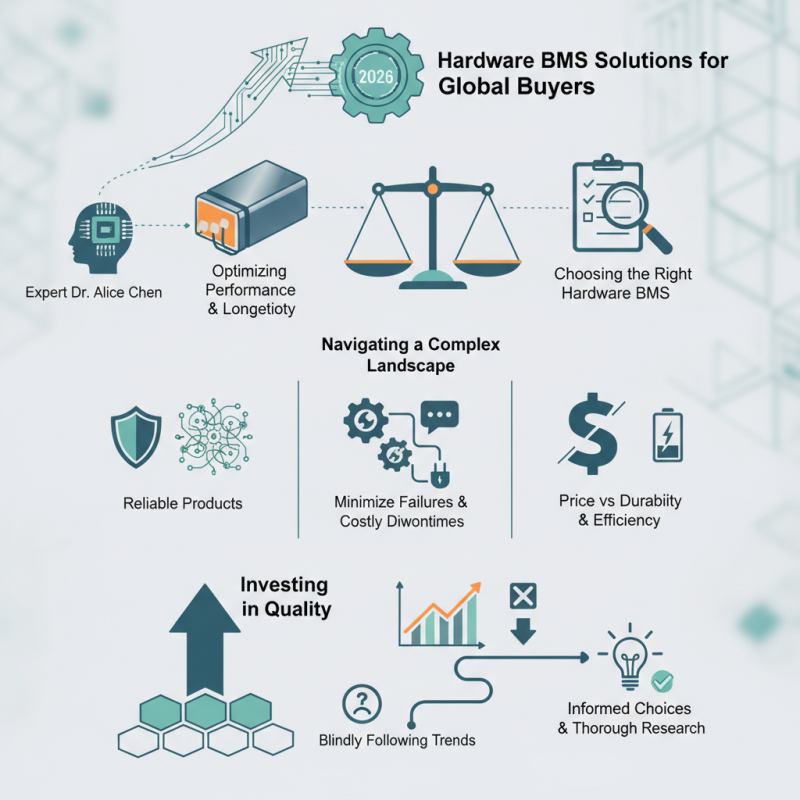
The Hardware BMS industry is evolving rapidly, driven by advancements in technology and increasing demand for efficient energy management. Renowned expert Dr. Alice Chen, a leading authority in energy systems, once stated, “Choosing the right Hardware BMS is crucial for optimizing performance and longevity.” This highlights the pressing importance of selecting suitable solutions in a competitive market.
Many buyers are navigating a complex landscape. With numerous options available, distinguishing reliable products requires a discerning eye. Features, compatibility, and support are vital factors. However, some buyers may focus too heavily on price alone, overlooking critical aspects like durability and efficiency. A well-chosen Hardware BMS can significantly impact overall energy efficiency and operational success.
Investing in a quality Hardware BMS solution can also minimize potential failures and costly downtimes. Yet, blindly following trends can lead to regrettable decisions. It’s essential to prioritize informed choices based on specific needs and thorough research. The future of Hardware BMS solutions promises innovation, but careful consideration will shape better outcomes for global buyers.
Overview of BMS Hardware Solutions for Global Buyers
Battery Management Systems (BMS) are crucial for efficient energy storage and management. In 2026, global buyers will face various choices. Understanding the hardware solutions available is essential for optimizing battery performance. Reports suggest that the market for BMS hardware solutions is expected to grow at a CAGR of 20% from 2023 to 2030. This growth indicates increasing demand for advanced technologies in the energy sector.
The key features buyers should consider include real-time monitoring, fault detection, and safety protocols. Effective BMS solutions ensure longer battery lifespan and enhanced energy efficiency. Sources indicate that top-performing systems can reduce operational costs by up to 30%. However, integrating advanced BMS technologies can pose challenges. Companies should be prepared for potential compatibility issues and long development cycles.
While the reported benefits are significant, it is crucial to evaluate the long-term implications. The initial investment can be substantial. In many cases, companies may overlook the importance of regular updates and maintenance. This negligence can lead to performance degradation over time. As the industry evolves, buyers must also stay informed about emerging trends and technological advancements in the BMS landscape. Being proactive is vital for reaping the maximum benefits from these essential systems.
2026 Best Hardware BMS Solutions for Global Buyers
| Feature | Description | Compatibility | Cost (USD) | Warranty |
| Cell Monitoring | Real-time monitoring of individual cell voltages | Lithium-ion, LiFePO4 | $150 - $300 | 2 years |
| Temperature Management | Integrated temperature sensors for optimal performance | Li-ion, NMC | $200 - $400 | 3 years |
| Safety Features | Overvoltage, undervoltage and short-circuit protection | All battery types | $100 - $250 | 1 year |
| Data Logging | Logging and analysis of performance data over time | Li-ion, Lead Acid | $180 - $320 | 2 years |
| Communication Protocols | Supports CAN, RS485, and Bluetooth | Compatible with various smart devices | $250 - $500 | 2 years |
Key Features to Consider in BMS Hardware Solutions
When evaluating hardware Battery Management System (BMS) solutions, several key features stand out. A reliable BMS must ensure safety through robust cell monitoring. Effective voltage and temperature readings are vital. These help prevent thermal runaway and optimize performance. Additionally, the BMS should offer real-time data analysis. It enables users to track battery health and make informed decisions quickly.
Another crucial feature is communication ability. The system should seamlessly integrate with different devices and networks. This allows for easy monitoring and data retrieval. Compatibility with both wired and wireless protocols is a plus. Moreover, longevity is an essential aspect. A durable BMS can lead to better battery life and reduced replacement costs.
However, even the best systems have imperfections. Users often experience difficulties with software updates. Regular maintenance is necessary to keep the hardware running smoothly. It also raises questions about the reliability of specific components. Potential buyers should consider these factors when choosing their systems. Understanding both strengths and limitations will lead to better choices in BMS solutions.
Top BMS Manufacturers and Their Offerings for 2026
As we approach 2026, the demand for Battery Management Systems (BMS) has surged. Many manufacturers anticipate requirements will evolve, enhancing performance and safety. This industry focuses on innovation and reliability to support various applications, including electric vehicles and renewable energy storage.
Some manufacturers are exploring advanced algorithms for battery health monitoring. These systems track charge cycles and temperature fluctuations. They help optimize battery lifespan significantly. Many consumers are looking for energy-efficient solutions. Thus, innovation in BMS design has become crucial.
Tips: When selecting a BMS, prioritize compatibility with your battery type. Inquire about customer support and warranty options. Exploring specifications thoroughly can aid informed decisions.
While there are many impressive offerings, challenges remain. Some systems may lack scalability for diverse applications. Durability under extreme conditions is another concern. Therefore, assessing these factors is essential before making a commitment. Understanding ongoing developments can also help you stay ahead in this evolving market.
Emerging Trends in BMS Technology for Global Markets
The battery management system (BMS) landscape is evolving rapidly. Emerging trends indicate a growing focus on smart technology integration. Features like real-time monitoring and predictive analytics are becoming standard. This shift enhances safety and efficiency. Companies are now prioritizing user-friendly interfaces, making data accessibility easier for stakeholders.
Another trend is the emphasis on sustainability. Manufacturers are looking into eco-friendly materials for BMS hardware. This move aligns with global environmental goals. However, there are challenges in balancing performance with sustainability. The integration of renewable energy sources also necessitates BMS adaptability. It is crucial for systems to support various battery chemistries.
Moreover, cybersecurity has become a pivotal concern. As BMS technology links to the Internet of Things, the risk of cyber threats increases. Organizations must invest in robust security measures. Many are still grappling with optimal solutions. The journey toward a more secure and efficient BMS system is ongoing. There is much to learn and improve in this evolving field.
Comparison of BMS Solutions: Cost, Performance, and Reliability
When evaluating Battery Management System (BMS) solutions, cost is a significant factor. Buyers must assess initial expenses, maintenance costs, and the long-term value of each system. A compelling BMS may demand a higher upfront investment, yet it can lead to savings over time. Lower-cost options may compromise on quality or features. Understanding these trade-offs is essential.
Performance metrics are crucial for decision-making. A BMS should efficiently monitor battery health, charge cycles, and temperature levels. Inconsistent performance can lead to battery damage or safety issues. Buyers should look for solutions that offer real-time analytics and robust reporting features. This data can help in identifying performance bottlenecks and potential failures before they occur.
Reliability impacts the overall user experience. A BMS must operate effectively under various conditions. External factors like temperature fluctuations or voltage dips can affect performance. It’s vital to research user reviews and case studies to gauge how different solutions perform in real-world scenarios. Reliability can sometimes be overlooked, but it’s key for maximizing battery lifespan and ensuring safety.
2026 Best Hardware BMS Solutions Comparison